
Phillip Island was supposed to say goodbye to MotoGP with one final Grand Prix. Another start. Twenty-seven laps. A few overtakes that seemed impossible until someone made them happen. And one last chequered flag to close almost three decades as a regular stop on the World Championship calendar. Instead, on Sunday, October 25, nobody raced.
Poor weather and reduced visibility prevented the medical helicopter from operating safely. After hours of delays, Race Direction cancelled the Moto3 and Moto2 races, followed by the premier-class Grand Prix. It was a necessary decision. No race can begin without the emergency medical arrangements required to protect the riders. But it was also an ending nobody wanted.
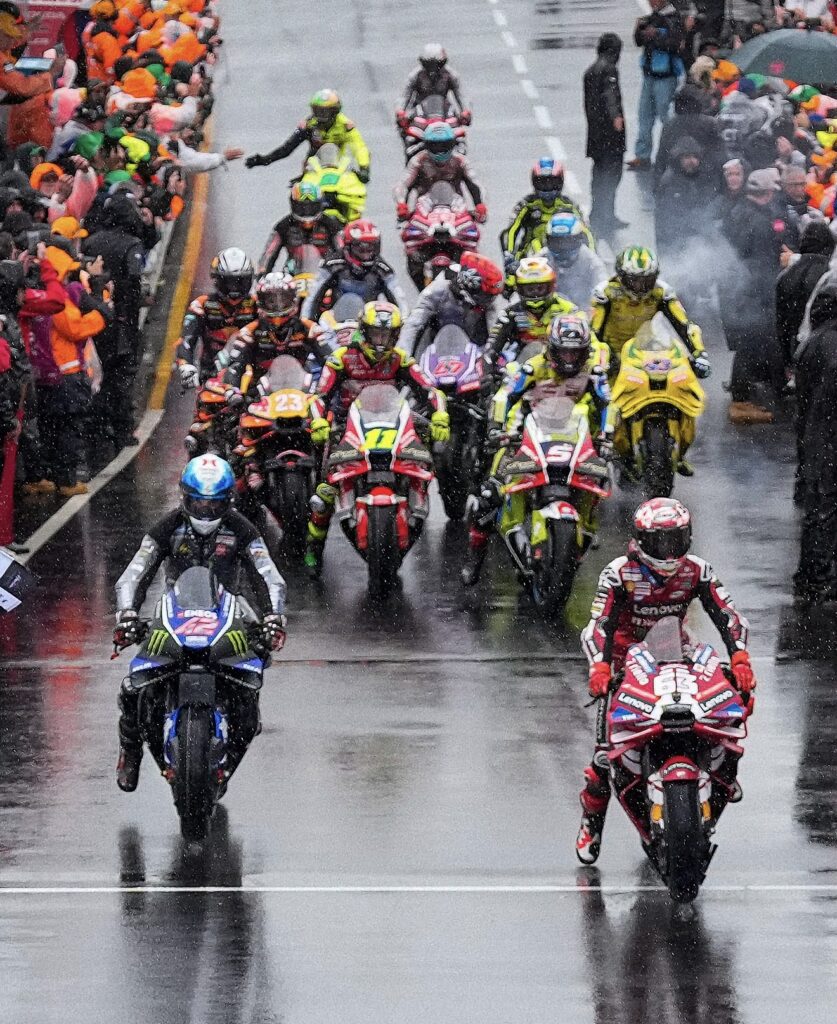
The MotoGP riders eventually took to the circuit behind the safety car for two farewell laps, stopping on the main straight to acknowledge the fans who had remained despite the rain. No battle for victory. No podium.
Just one last moment together.
From 2027, the Australian Grand Prix will move to a new street circuit in Adelaide. Phillip Island will continue hosting other forms of motorsport. The circuit itself is not disappearing. But its MotoGP chapter is coming to an end. And before turning towards the future, there is something worth remembering.
🇮🇹 Preferisci leggere l’articolo in italiano? Leggi qui la versione completa.
Phillip Island: a circuit unlike any other
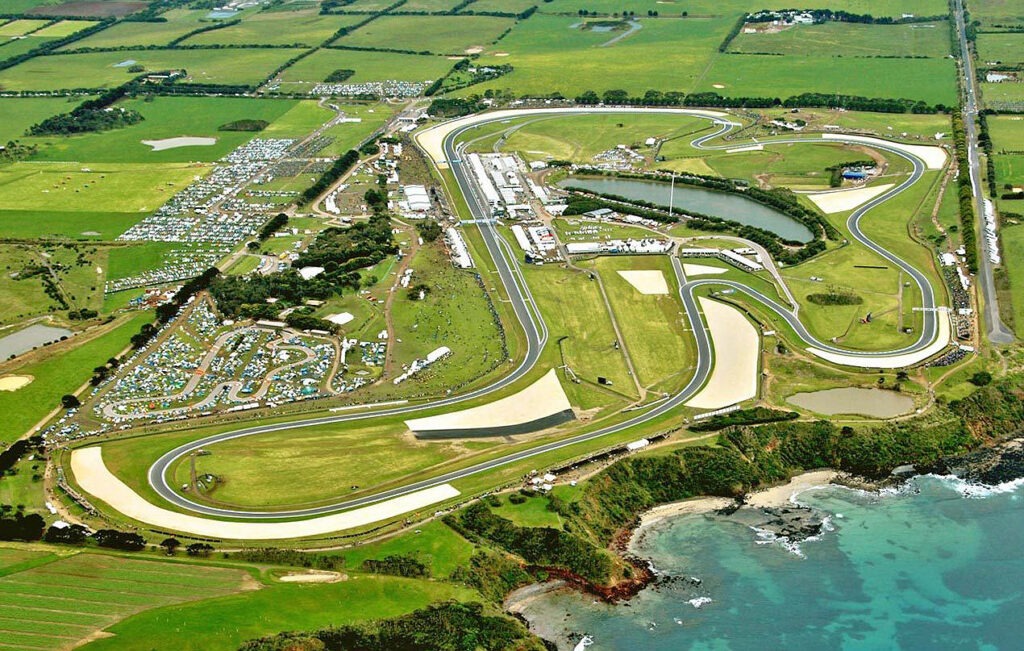
Phillip Island is one of those places you recognise before the motorcycles even appear. The ocean beyond the circuit. Green hills surrounding the asphalt. Wind arriving from the Bass Strait. A ribbon of tarmac that seems to follow the landscape rather than interrupt it. Just under four and a half kilometres of high-speed corners, flowing changes of direction and sections where carrying speed matters as much as braking late. It is not a circuit defined by a sequence of heavy braking zones.
Riders need confidence while the motorcycle is already leaned over. They must prepare one corner through the exit of the previous one, often without a clear moment separating the two. For anyone watching, the result is distinctive. The motorcycles seem to flow across the track. And when two riders are close together, an overtake can begin several corners before it is finally completed.
Phillip Island did not become special because it automatically delivered the best race of every season. It became special because it offered so many opportunities for extraordinary racing to happen.
Gardner, Doohan and Stoner: the riders who became part of the circuit
Some circuits remember their champions through photographs, trophies and commemorative plaques. Phillip Island has gone further. It has given them the names of its corners. The main straight is Gardner Straight. At its end comes Doohan Corner, Turn 1. A little further around the lap is Stoner Corner, Turn 3, followed by Miller Corner at Turn 4. Four Australian names accompanying the riders through the opening section of every lap.
They are more than tributes. They are part of the circuit’s identity.
Gardner and Doohan: Australia’s first home heroes
It begins with Wayne Gardner.
When the World Championship first arrived at Phillip Island in 1989, Gardner was already Australia’s first 500cc World Champion, having won the title in 1987. He had also played an important role in bringing Grand Prix motorcycle racing to the island. Then he won the inaugural race. Following an intense battle with Wayne Rainey, Christian Sarron and Kevin Magee, Gardner brought his Honda home in front of the Australian fans.
In 1990, he won again, this time despite a wrist injury. Two Grands Prix at Phillip Island. Two victories. And a circuit that had already found someone who represented what racing there meant to the home crowd.
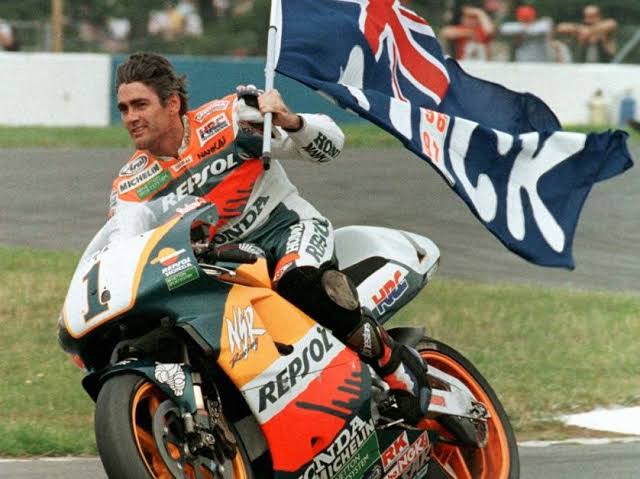
Then came Mick Doohan.
Five consecutive 500cc World Championships between 1994 and 1998, and a home victory in 1998 that also secured his fifth world title. Today his name belongs to Turn 1, immediately after the straight named for Gardner. As though one generation is leading the next into the lap.
Casey Stoner: six years of domination
But if one rider made Phillip Island feel almost like his own territory, it was Casey Stoner.
Six consecutive MotoGP victories, from 2007 to 2012. First with Ducati, then with Honda. In 2011, he secured his second World Championship at Phillip Island, on his 26th birthday. In 2012, approaching retirement, he returned for one final home victory.
His name now belongs to Turn 3, one of the fastest left-hand corners on the circuit. A place that demands confidence, commitment and precision. It is difficult to imagine a more fitting tribute to the way Stoner rode.
Miller and Agius: the Australian story continues
But the Australian story does not end with World Champions.
In 2014, Jack Miller won the Moto3 race at Phillip Island, beating Alex Marquez by just 0.029 seconds. A home victory decided almost on the finish line. Eight years later, in 2022, Turn 4 was named after him. And in 2025, another Australian name joined the circuit’s Grand Prix history.
Senna Agius won the Moto2 race, becoming the first Australian to win a Moto2 Grand Prix on home soil at Phillip Island. A reminder that the circuit’s story did not belong only to riders whose careers had already become legendary. It was still creating new memories right until its final seasons.
Gardner, Doohan, Stoner, Miller, Agius. Different generations. Different careers. The same connection to an island where winning meant something particular. Racing in front of your own people is an experience many riders dream about. Having your name become part of the circuit is something else entirely.
Rossi and the races that could tell completely different stories
Phillip Island was never only the home of Australian racing heroes. It also became the setting for some of the most memorable performances by the sport’s international stars.
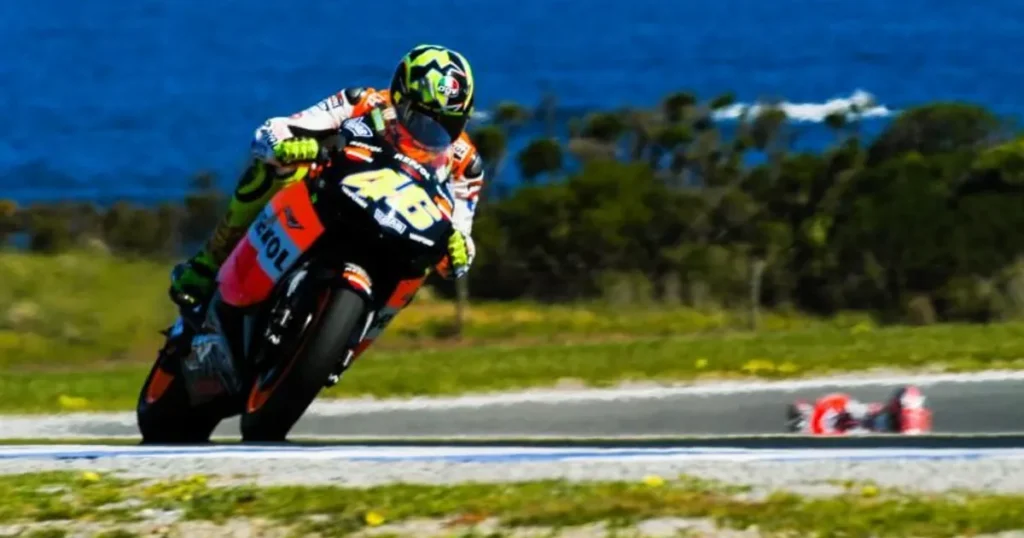
Valentino Rossi provided two particularly different examples.
In 2003, he received a ten-second penalty for overtaking under yellow flags. He could have focused on limiting the damage. Instead, he pushed harder, building more than fifteen seconds of advantage on the road and still winning officially by 5.212 seconds after the penalty had been applied. One year later, the challenge was entirely different. Rossi fought Sete Gibernau until the closing metres and won by just 0.097 seconds, also securing the 2004 World Championship. One victory against the clock. Another settled almost at the finish line. Two races, two completely different challenges, on exactly the same circuit.
That is part of what made Phillip Island extraordinary. It could tell opposite stories without changing a single corner.
The races nobody wanted to end
Every MotoGP fan probably has at least one Phillip Island race they would happily watch again.
For many, it is 2015.
Marc Marquez, Jorge Lorenzo, Valentino Rossi and Andrea Iannone spent the race exchanging positions, attacking and responding through a succession of corners that barely allowed anyone to predict the next move. Marquez won ahead of Lorenzo, with Iannone taking third in front of Rossi. It was not simply a close race. It was a Sunday when the outcome remained uncertain almost until the final moment.
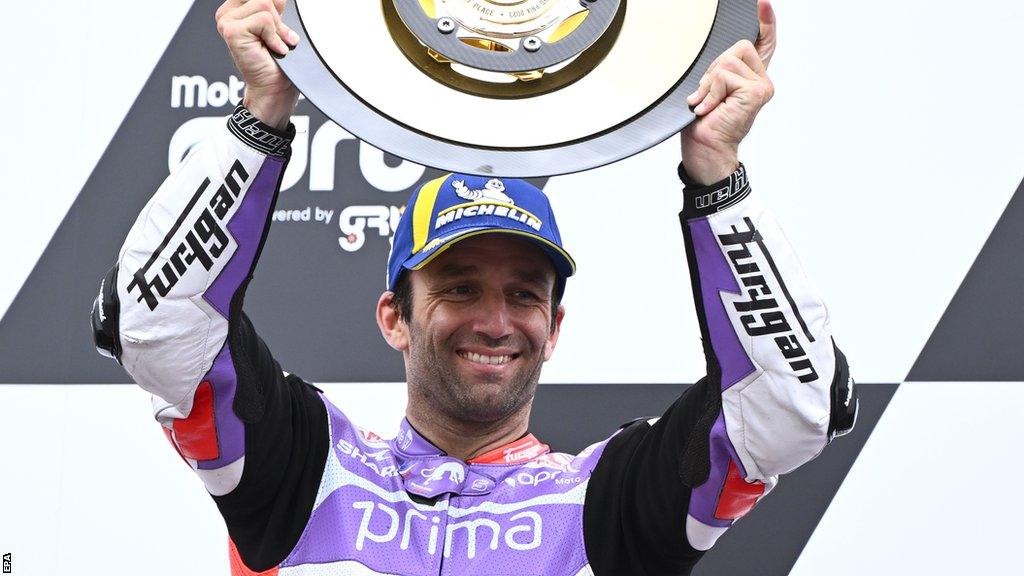
In 2022, Alex Rins delivered another unforgettable finish, winning for Suzuki ahead of Marc Marquez and Francesco Bagnaia. The winning margin was just 0.186 seconds. Then came 2023. Jorge Martin had led almost the entire race and appeared to have built a decisive advantage on the softer rear tyre. But in the closing laps, the grip began to disappear. The chasing group closed in. And on the final lap, Johann Zarco made the move that gave him his first MotoGP Grand Prix victory. Bagnaia finished second. Fabio Di Giannantonio took third. Martin, who had looked set for victory for so long, ended up fifth. A tyre choice, a disappearing advantage and a first win years in the making. All inside one Grand Prix.
Phillip Island had a particular way of making the final lap feel like the moment when the race truly began.
Phillip Island: one last record, signed Fabio Quartararo
Among the many stories Phillip Island leaves behind, one is written entirely against the stopwatch.
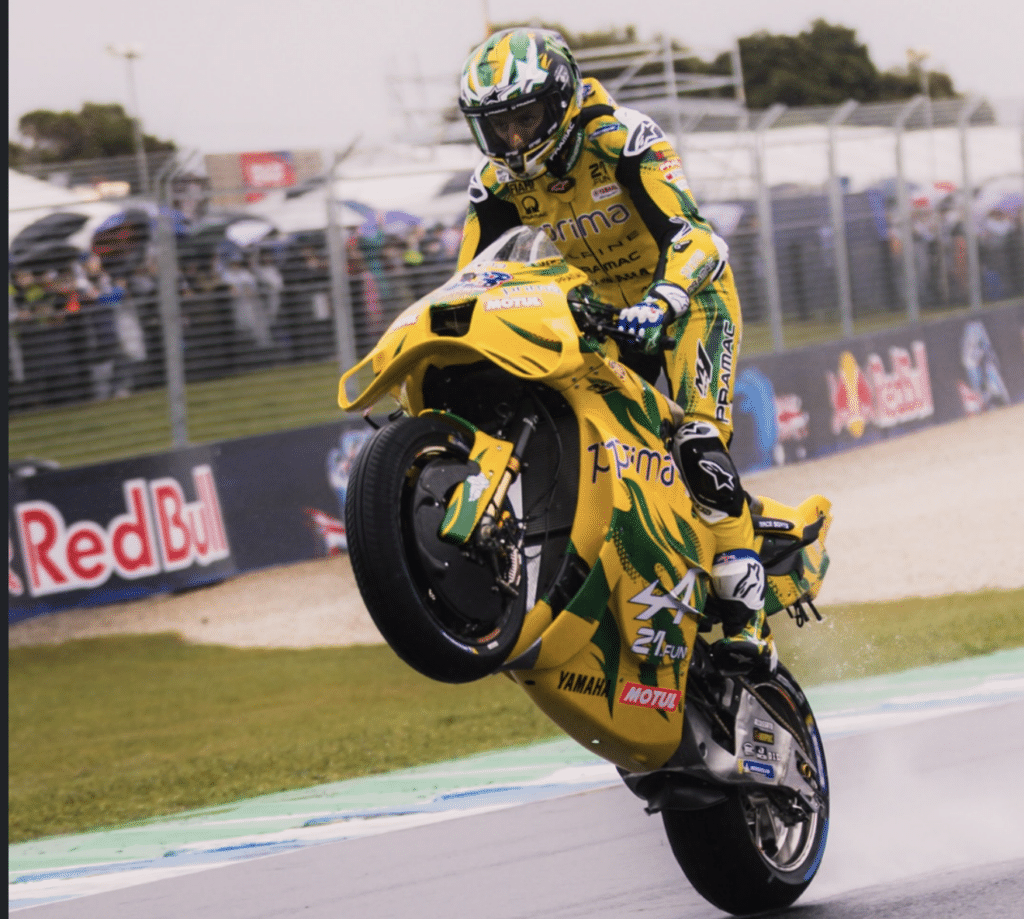
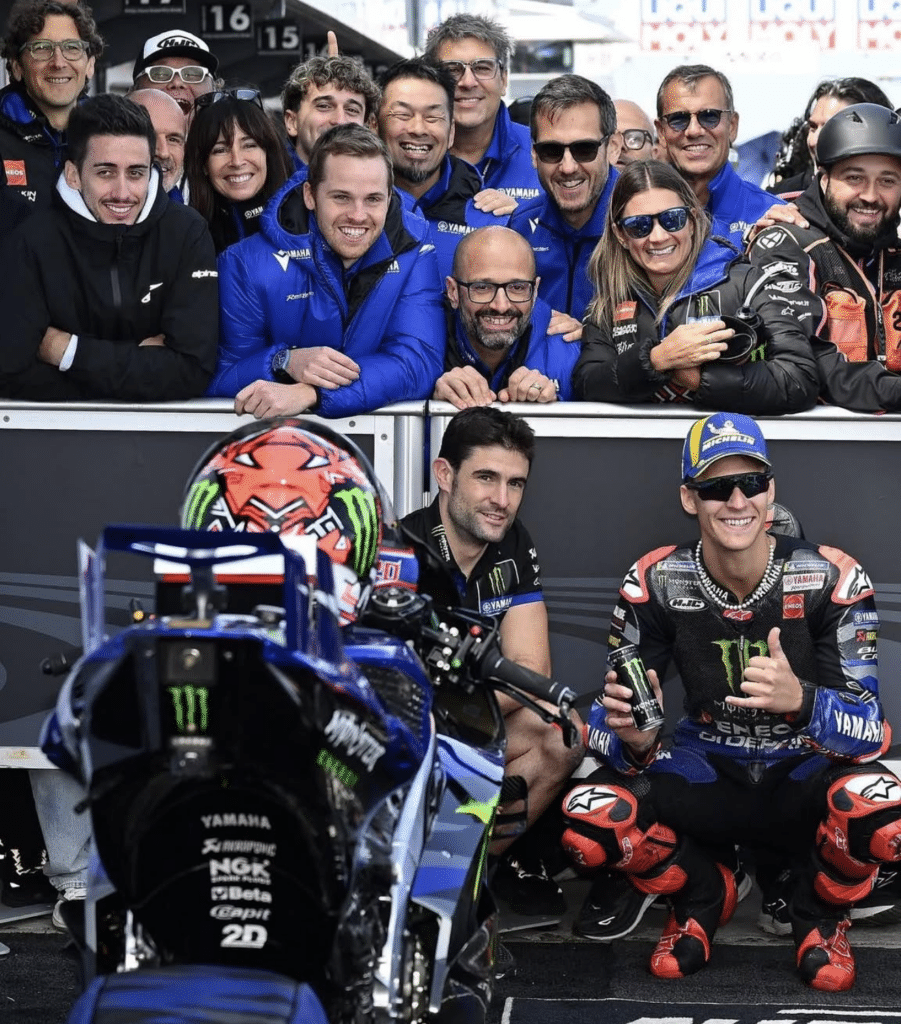
On October 18, 2025, during qualifying for the Australian Grand Prix, Fabio Quartararo took his Yamaha around Phillip Island in 1’26.465. It gave him pole position. And it established a new outright MotoGP lap record. Marco Bezzecchi qualified second. The difference between them was just 0.031 seconds.
Two riders. Two different motorcycles. Thirty-one thousandths separating them. And a lap that, one year later, nobody has managed to improve.
It is important to distinguish the outright lap record from the fastest race lap, which belongs to Marc Marquez with a 1’27.765 set in 2024. Quartararo’s time remains the fastest MotoGP lap ever recorded at Phillip Island. Rain affected the final qualifying session in 2026, and Sunday’s cancellation brought the weekend to an end without a Grand Prix. So unless MotoGP eventually returns to the island, that 1’26.465 will remain the benchmark.
The calendar will change. The motorcycles will continue evolving. But the final chapter of Phillip Island’s MotoGP record book still carries Fabio Quartararo’s name. And he set it on a Yamaha.
One final Sprint, then a silent Sunday
The 2026 weekend still managed to provide one last chapter of competitive racing. On Saturday, Marc Marquez won the Sprint ahead of his brother Alex and Fabio Di Giannantonio, who celebrated his second consecutive Sprint podium. Marco Bezzecchi recovered to fourth after dropping as low as twelfth in the early stages. Jorge Martin, meanwhile, crashed while fighting Marquez for the lead, suffering a fracture of his right radius that ruled him out of Sunday’s Grand Prix. The result left Marquez ten points ahead in the World Championship.
Sunday was supposed to offer the next chapter. Bezzecchi would try to move forward from ninth on the grid. Di Giannantonio would look to build on another strong Saturday. Bagnaia would search for answers after yet another difficult Sprint. And the final Australian Grand Prix at Phillip Island would have its winner. Instead, there was no race. With the Grand Prix cancelled, no Sunday championship points were awarded. The standings remained as they were after Saturday.
For Martin, it meant not losing further ground while injured. For Marquez, it meant losing an opportunity to extend his lead, while for every other rider, it meant an opportunity that simply disappeared. But reducing this Sunday to the championship points that were never awarded would miss something important. Phillip Island was saying goodbye to much more than one round of the 2026 season.
One final ride for those who stayed
The weather had disrupted Sunday’s programme from the early hours. The MotoGP warm-up was first delayed and then cancelled. Then, the Moto3 and Moto2 races were called off. And Race Direction continued searching for a window that would allow the premier-class Grand Prix to take place. It never came. Poor visibility meant the medical helicopter could not operate as required. Without that essential safety provision, racing was not possible. Meanwhile, fans were still waiting around the circuit. People who had travelled long distances, endured the rain and hoped to see MotoGP motorcycles race through those corners one final time.
They did not get the race. They got the riders.
Two parade laps behind the safety car turned the circuit into something different. No positions to recover. No lap times to improve. Just motorcycles, riders and the people who had stayed. Australian favourite Jack Miller stopped to acknowledge the crowd, giving away gloves and boots to fans.
A small gesture at the end of a day that had taken away the experience everyone had come to see. It could not replace a Grand Prix. And it could not erase the disappointment. But it said something about the relationship Phillip Island had built with its audience. A circuit is not just the sum of its corners. It is also the people who travel there, the marshals who work there, those who wait in the rain and those who remember exactly where they were when somebody made an overtake that seemed impossible.
Adelaide is the future. Phillip Island remains part of MotoGP
From 2027, the Australian Grand Prix will have a new home.
Adelaide will introduce a different setting and a new city-centre circuit. It will be a new experience for the championship, one to discover and judge when the motorcycles finally race there. There is no need to decide today whether it will be better or worse. But it is right to recognise that it will not be the same.
What Adelaide cannot take away
Phillip Island had something that cannot simply be moved to another location. The ocean and the wind. The way its corners followed one another and the history of the races that took place there. And the feeling that almost any Grand Prix could change, even when the winner appeared to be decided.
Perhaps MotoGP will return one day. Perhaps it will not. What we know is that this chapter has ended without the final race it deserved. There is disappointment in that. Inevitably. But an imperfect ending cannot erase everything that came before it.
Phillip Island gave us Gardner and Doohan, Stoner and Miller, and a home victory for Agius.
It gave us Rossi’s impossible recovery in 2003, Iannone’s podium in 2015 and Zarco’s long-awaited first victory. It gave Quartararo a lap record that remains unbeaten. And it gave generations of fans a reason to wake up in the middle of the night to watch motorcycles race on an island on the other side of the world.
Today there was no final chequered flag. There were two last laps, slower than all the others. And perhaps the best way to say goodbye is to remember the ones when nobody wanted to slow down.
Goodbye, Phillip Island.
And thank you for every race you gave us.
LINK:
Read: Marquez wins Australian Sprint as Martin crashes out: Diggia on the podium, Bezzecchi fights back to fourth
Watch: Farewell Lap & Rider Parade | 2026 Australian GP
